

SMS MT (Mobile Terminated) is a text message delivered to the recipient's phone, e.g. from a company's system. This is how customers receive authorisation codes, order notifications or appointment reminders. Combined with messages sent by users, it also enables two-way communication. The abbreviation MT also appears in the name of paid Premium subscriptions. How do these uses differ and what does a message exchange between a company and a customer look like?
Table of contents
The abbreviation MT comes from the English Mobile Terminated. It denotes a message whose journey ends on the recipient's mobile device. The term describes the direction of communication, not the type of content or the sending method.
In business use, it most often refers to SMS passed from a company system to a customer's phone. This model is A2P (Application-to-Person), i.e. communication between an application and a user. From the company's perspective, these are outgoing messages (outbound SMS).
Not every MT message comes from an application, though. The same term can be applied to an SMS delivered to a phone in ordinary correspondence between two people.
Companies use such messages, among other things, to send OTP codes, booking confirmations, delivery information and marketing offers.
Your order no. 12345 has been shipped. We will let you know when the parcel is ready for pickup.
A shop can send such a notification automatically when the order status changes.
Both abbreviations describe the direction of a message relative to the user's phone. MO (Mobile Originated) denotes an SMS going out from the phone, and MT – a message delivered to it.
| Element | SMS MO (Mobile Originated) | SMS MT (Mobile Terminated) |
|---|---|---|
| Direction | From the user's phone to a recipient or system | To the user's phone |
| Who initiates the message | The phone user | The sender, e.g. a company or another user |
| Examples | A „TAK” („yes”) reply, contest entry, enquiry | OTP code, order status, appointment reminder |
| Who pays | Usually the sender, according to the tariff; exceptions include Premium MO SMS | Usually the sender or the company ordering the sending; the Premium MT model was an exception |
| Typical sender in business communication | The customer's phone number | A phone number or an alphanumeric company name |
The MO and MT labels alone do not determine the fees. They describe the flow of the message, not its price.
Sending a business SMS usually starts in the service provider's panel, a CRM system, an online shop or another application. The message then passes through the SMS gateway and the operator's infrastructure until it reaches the addressee's phone.
A message can be prepared manually or sent automatically. In the latter case, SMS API is often used – an interface connecting the company's system with the SMS gateway.
With automated sending, the system passes the recipient's number and the message content to the gateway. From there, the message is handled by the telecommunications infrastructure.
SMS-FLY provides an API that lets you integrate sending with business software. The service page lists, among others, HTTP API, Web Service and the SMPP protocol.
Once the gateway accepts the message, it is passed to the infrastructure responsible for delivery. An important role is played by the SMSC (Short Message Service Centre), which is responsible for accepting messages, forwarding them and handling delivery attempts.
Information is exchanged between systems using, among others, the SMPP protocol (Short Message Peer-to-Peer). Two important operations are:
These are operations for communication between systems. A user of an SMS panel does not need to handle them.
After sending, the system may receive a delivery report, i.e. a DLR (Delivery Receipt). Depending on the statuses available, it shows, among other things, whether the message reached the recipient or whether the delivery attempt failed.
A delivery report does not confirm that the SMS has been read. It shows the status of the message in the network, not whether the recipient has read its content.
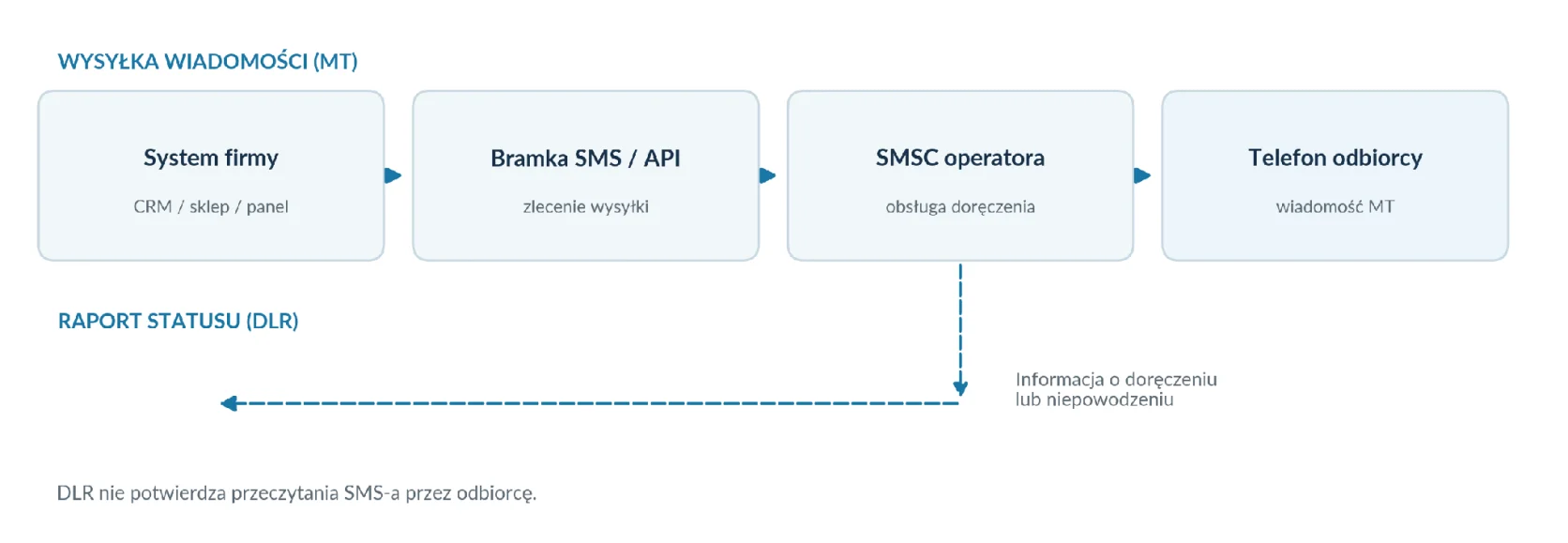
Tap the diagram to enlarge it
Diagram 1. The SMS journey to the recipient and the return of the DLR report.
The report returns to the company's system through the infrastructure that handles the sending.
Sending a notification alone does not create a dialogue yet. For the customer to be able to reply, the company must be able to receive and handle their message.
Two-way SMS communication means combining MO and MT messages in a single process. The customer sends an SMS to a number that supports incoming messages, the system receives its content and can then perform a defined action and send a reply.
This way you can handle simple confirmations, requests or surveys without a phone call.

Keywords are one way of handling incoming messages. The system recognises a specific reply from the user and triggers the action assigned to it.
Example exchange:
Company: A reminder about your appointment tomorrow at 14:00. Send TAK to confirm, or NIE to cancel.
Customer: TAK
System: Thank you. Your appointment has been confirmed.
The patient's reply is an MO message, and the reminder and confirmation sent by the clinic are MT messages.
Receiving an SMS alone is not enough for the system to recognise the message content and react automatically. Properly configured rules are needed.
Companies often send SMS with a sender name, e.g. „SKLEP”, instead of a phone number. Such an alphanumeric sender name makes the sender easier to recognise, but does not let the recipient reply directly to the message.
Two-way communication requires a number that supports incoming messages. It can be a suitably configured nine-digit number (long code) or a short number (short code).
SMS-FLY lets you receive replies through the Individual Access Number (NDI). Incoming messages are visible in the Client Panel, from where they can be forwarded to e-mail or to a company system via API.
Before launching such communication, you need to decide where customers' replies will go: to the panel, to e-mail or to the company's system. If they are to trigger automatic actions, rules for handling them must also be defined.
Want to launch two-way SMS communication? Check the options for receiving replies through an NDI number and integration with the SMS-FLY API. Contact the team to choose a solution that fits the way your company serves customers.
Depending on the process, an SMS can inform about a shipment, deliver an authorisation code or collect survey answers.
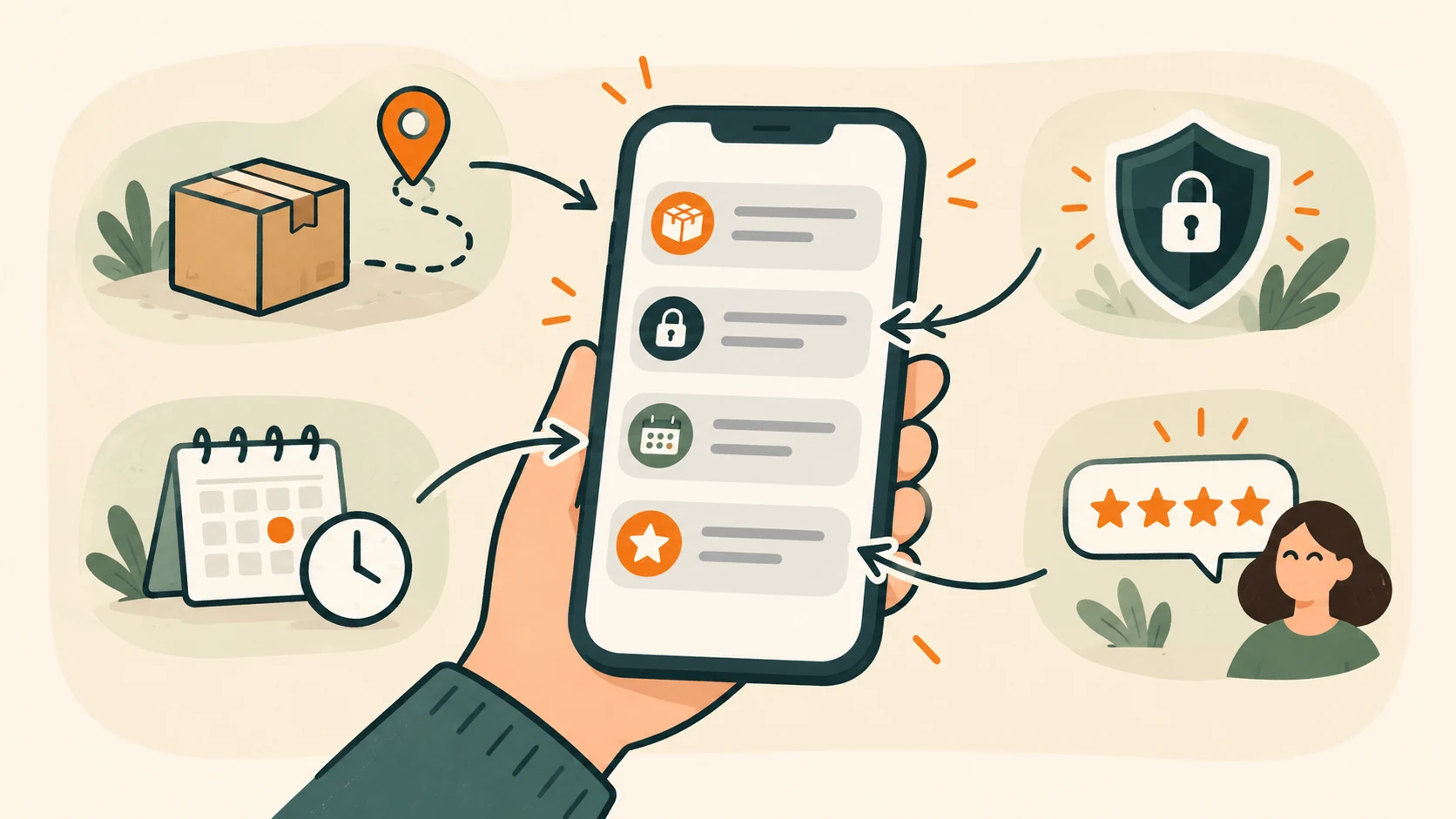
A transactional SMS can inform about an order being accepted, a change in its status or a parcel being handed over for delivery.
Your order no. 12345 is ready for pickup. Thank you for shopping with us.
Medical facilities send appointment reminders. If they use a number that can receive replies, they can also collect confirmations from patients.
A reminder about your appointment on 15 October at 10:30. To confirm, reply TAK.
An authorisation SMS can contain a one-time OTP code (One-Time Password), used to confirm selected operations or log in, depending on the provider's procedures.
Authorisation code: 482913. Do not share it with anyone.
Courier companies inform about delivery stages, the parcel being handed to the courier or the possibility of picking it up.
Your parcel has been handed to the courier for delivery.
Two-way communication lets you collect votes, survey answers and contest entries. The user sends back the indicated digit or keyword to a number that supports incoming messages.
Rate your last visit on a scale from 1 to 5. Send back the chosen digit in reply to this message.
These are example messages, not ready-made scenarios available in every configuration.
In the context of Premium services, the abbreviation MT refers to a special billing model. In a classic paid subscription, the user paid for the messages they received.
Services of this type regularly delivered ordered content, e.g. horoscopes, weather forecasts or entertainment news. After activation, the customer received further SMS, for which fees were charged according to the terms and conditions.
Several activation methods were used:
In the model described by HotPay, the user received a free welcome message with the service name, information about costs and the frequency of charges, the organiser's details, access to the terms and conditions and instructions on how to unsubscribe.
Historical descriptions of Premium services listed, among others, the number ranges 5XXXX, 6XXXX and 80XX for the model with a fee for received messages (Premium MT), and 7XXX and 9XXXX for paid messages sent by users (Premium MO). These are examples of numbering used in the past, not a complete list of currently active services.
The way these services historically worked must be distinguished from their availability today. Since 1 November 2018, Orange has not allowed new subscriptions based on regular delivery of paid messages to be ordered. HotPay, in turn, reports that Polish operators have stopped offering registration of classic subscription services.
The restrictions concern classic subscriptions, not all Premium services. Direct Billing is a separate solution – a fee for a purchase or service may be added to the phone bill, but it is not charged for receiving a specific SMS.
If an unknown charge appears on your phone bill, start by checking the service name, the number and its provider. The register of numbers used for premium-rate services, kept by the Office of Electronic Communications (UKE), can help.
For an active subscription, follow the unsubscribe instructions given in the terms and conditions or in the welcome message. The command used was often STOP, sometimes followed by the service name. However, it is not a universal command that works in every service.
If you cannot end the subscription, contact your operator. You can also request a free block on Premium services. It is worth confirming separately that the specific subscription has ended and that a block preventing further payments has been enabled.
The Polish Electronic Communications Law provides for spending thresholds for premium-rate services. The operator must offer at least four values: PLN 0, 35, 100 and 200. If the subscriber does not choose a threshold, the default limit is PLN 35 per billing period or, if there is none, per calendar month.
If you suspect a fee was charged without the required consent, it is worth filing a complaint and asking for an explanation. In certain cases, when the service was provided in breach of statutory obligations, the provider cannot demand payment for it.
The rules for sending SMS also depend on the purpose of the message.
A marketing SMS requires the recipient's prior consent. This follows from Art. 398 of the Polish Electronic Communications Law, which regulates the use of, among others, telecommunications terminal equipment to send commercial information, including direct marketing.
Simply having a customer's phone number does not give grounds for sending them advertising offers.
Purely transactional messages are treated differently, e.g. an order confirmation, delivery information or an authorisation code. They are not automatically marketing and, as a rule, do not require marketing consent under Art. 398. Other regulations still apply, however, including those on personal data protection. Adding advertising to a service message may change its nature.
Protection against sender impersonation is also important. The Polish act on combating abuse in electronic communications, which came into force on 25 September 2023, introduced measures against, among others, smishing, i.e. attempts to extort information via SMS.
Under this act, operators have obligations related to blocking messages that match smishing patterns provided by CSIRT NASK. CSIRT NASK also maintains a list of SMS sender names reserved for public entities.
When planning business communication, you therefore need to ensure both a proper legal basis for sending and the security of the content and the way the sender is identified.
MT stands for Mobile Terminated. It denotes a message delivered to the recipient's phone. In business use it most often refers to an SMS sent from a company's application or system.
MT describes a message directed to a phone, and MO (Mobile Originated) – a message sent from a phone. Both directions can be combined in two-way communication, e.g. when a customer replies to an appointment reminder.
Yes, if the sender uses a number that supports incoming messages. You cannot, however, reply directly to a standard alphanumeric sender name, e.g. „SKLEP”.
In standard domestic communication, the recipient does not pay extra for receiving a regular message. The exception was, among others, the classic Premium model, in which the fee applied to the content delivered.
Check the service name and the unsubscribe instructions, then follow them. You can also contact your operator and request a free block on Premium services and a spending threshold set to PLN 0.
SMS-FLY provides tools for sending via API and receiving messages through an NDI number. Contact SMS-FLY to explore integration options and choose a communication method that fits your company's needs.