

SMS MO (Mobile Originated) is an SMS sent from a user's mobile phone, e.g. to another person, a company or an IT system. In business communication such messages are used to collect replies and requests from customers – from appointment confirmations and survey answers to instructions about orders.
Table of contents
The abbreviation MO comes from the English Mobile Originated, meaning „originating from a mobile phone”. It is a term used in telecommunications to describe the direction in which an SMS is sent, found, among others, in the 3GPP specifications.
From the user's point of view, SMS MO is simply a message they send from their phone. It can go to another person, to a number running a contest or to a company's system.
Companies most often come across the term SMS MO when they want to receive messages from customers. They provide a number to which the customer sends a question, a request or a reply with specific content. The SMS then goes to an employee or a system that handles it.
Two things are worth separating: SMS MO describes the direction of the message, while an SMS receiving service describes how it is read and handled.
The difference between SMS MO and SMS MT concerns the direction of the message relative to the user's phone. SMS MO (Mobile Originated) is sent from the phone, while SMS MT (Mobile Terminated) is delivered to the phone.
This split comes from the way the mobile network works. The same message sent between two phones is handled as MO on the sender's side and as MT on the recipient's side.
| Criterion | SMS MO | SMS MT |
|---|---|---|
| Direction | From the user's phone to the recipient | To the user's phone |
| Who initiates | The user sending the SMS | The person or system sending the message |
| Examples | Appointment confirmation, contest entry, survey reply | 2FA code, order notification, reminder |
| Number type | The recipient's number, e.g. standard or short | The sender can be identified by a number or a name |
| Who pays | Usually the sender, according to the tariff and number type | In typical business communication the company pays for sending, and the customer does not pay to receive a standard SMS |
| Typical uses | Receiving requests, replies and instructions | Notifications, reminders, marketing messages |
Booking confirmation is a good example. A salon sends the customer an appointment reminder (SMS MT), and the customer replies with the word TAK („yes”) (SMS MO). After receiving the reply, the system can automatically send another confirmation (SMS MT).
This is how two-way SMS communication (2-way SMS) works. It does, however, require a solution that can receive messages and handle them further.

Not every business SMS can be replied to. If a brand name is displayed instead of the sender's number, the customer usually cannot reply directly to the message received. The company then has to provide a separate contact number if it wants to receive SMS replies.
A2P (Application to Person) means messages sent from an application to a user, while P2P (Person to Person) refers to communication between people. A2P and P2P describe the participants of the message exchange, while MO and MT describe the direction of sending relative to the phone. That is why these terms should not be treated as interchangeable.
SMS MO reaches the recipient through the mobile network. When a company uses an SMS receiving service, the messages received can appear in a web panel or go straight into its system.
In a typical business scenario the process looks like this:
1. The customer sends an SMS. They enter the receiving number and the content, e.g. TAK, to confirm an appointment.
2. The message enters the operator's network. The telecommunications infrastructure accepts the SMS and routes it for further handling.
3. The SMS reaches the receiving service. Depending on the solution, an SMS gateway or an aggregator may act as an intermediary.
4. The company's system receives the message. The SMS appears, for example, in the panel, goes to an application via API or is forwarded to a specified e-mail address.
5. The request is handled. An employee reads the SMS or the system automatically performs a defined action and possibly sends a reply.
Message forwarding in the network is handled, among others, by the SMSC (Short Message Service Center). Communication between operator infrastructure and service providers' systems uses protocols such as SMPP. HTTP API interfaces, in turn, can be used to pass data about received SMS to business applications.
In practice, what matters most is whether the company can conveniently receive SMS, assign them to customers and respond appropriately.
SMS MO and MT message flow diagram
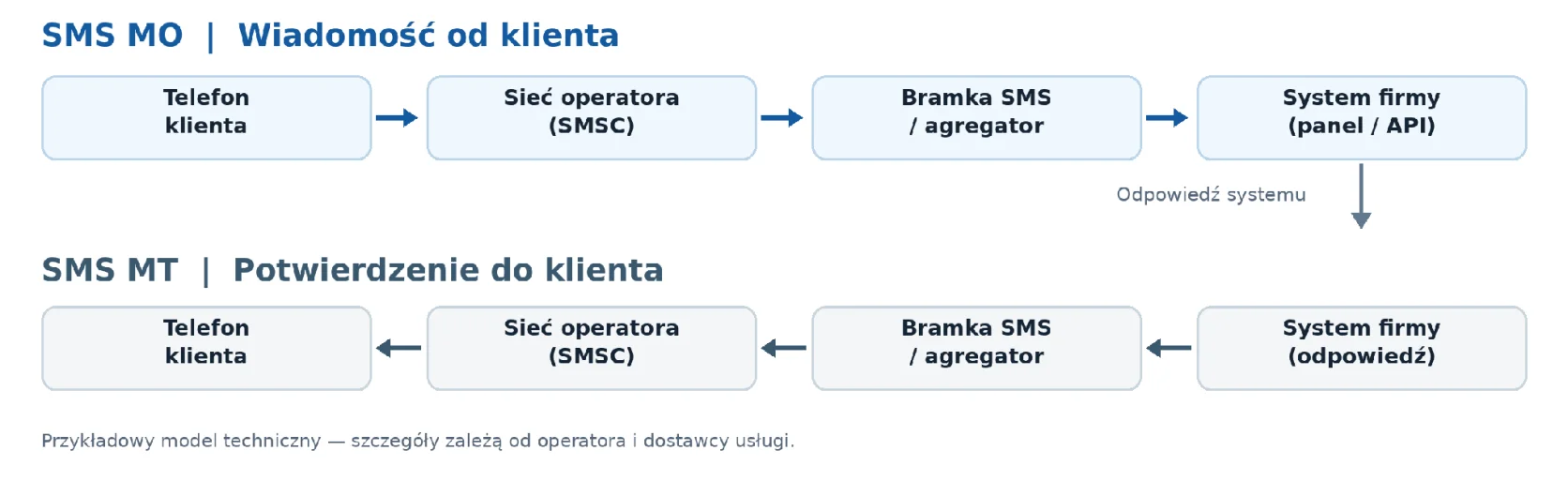
Tap the diagram to enlarge it
Diagram 1. Example flow of an SMS MO and an SMS MT reply.
A customer can send SMS MO to a regular phone number or to a number intended for receiving messages in a company. Business communication uses long and short numbers, provided exclusively or in a shared model. Premium numbers form a separate category.
A long number (long code) has the format of a standard phone number. In Poland it is usually a nine-digit number, the same as in everyday communication between users.
Business services also use virtual numbers handled by an SMS platform. Receiving messages then does not require a separate employee phone – the SMS are available in the panel or the company's system.
Long numbers are used, among other things, in customer service, handling requests and confirming bookings. Their advantage is a format users know well.
A short number (short code) consists of a few digits. SMS receiving services use, among others, four-digit numbers that are easy to remember and put in advertising materials.
A shorter number makes it easier to take part in a contest, a survey or an outdoor campaign. The user can type it in faster from a poster or a leaflet, without copying a long string of digits.
A short number does not have to mean a Premium service, though. Non-premium numbers are also available, but their tariff must be checked before the campaign starts. Not every message sent to a short code is covered by a standard SMS bundle.
A shared number can serve several campaigns or companies. For the system to recognise which of them a message belongs to, the sender puts a keyword, i.e. a prefix, at the beginning of it.
So two companies can use the same number but different prefixes.
Example instruction for the customer: „Send WIZYTA TAK to [receiving number] to confirm the appointment”.
A dedicated number, on the other hand, is assigned to a single client of the service provider. It does not require splitting messages between different companies based on prefixes, although keywords can still be used to handle individual processes.
A shared number can be convenient for short campaigns, while a dedicated one suits regular communication with customers.
SMS Premium MO is a message sent to a number linked to a premium-rate service, for which a specific fee is charged.
Such a solution can be used, for example, in paid voting, for access to digital content or in micropayments. However, it should not be equated with every SMS sent to a short number.
For SMS Premium MO, separate rules apply for charging fees and informing the user about the price of the service.
Comparison of numbers and SMS MO receiving models
| Number type or model | Example | Cost for the customer | Activation on the company side | Subscription for the company | Use |
|---|---|---|---|---|---|
| Long number | Format 5XX XXX XXX | According to the operator's tariff | Possible one-off fee | Possible subscription | Customer service, requests |
| Non-premium short number | Format 4XXX | According to the number's tariff | Depends on the provider | Depends on the provider | Surveys, OOH campaigns |
| Shared number | Number + prefix WIZYTA | Depends on the number | According to the shared model | According to the shared model | Campaigns, contests, confirmations |
| Dedicated number | A number assigned to one company | Depends on the number | Possible one-off fee | Possible subscription | Ongoing communication with customers |
| Premium MO number | E.g. range 72XXX or 925XX | Higher fee for the service | According to the contract terms | According to the contract terms | Micropayments, paid voting |
The table lists both number formats and ways they are provided. A dedicated or shared number can at the same time be a long or a short number. Entries with the letter X are example formats, not the numbers of specific services.
Activation and subscription rates should be checked in the chosen provider's price list. Without it, reliable amounts cannot be given.
For sending SMS MO, the customer pays according to the operator's tariff and the rules of the given service. A company that receives such messages through a platform settles with the platform provider.
An SMS to a regular nine-digit number is usually charged at the standard tariff. If the user has a suitable bundle, the message may be included in it.
For non-premium short numbers, the rules depend on the specific number and operator. So you should not assume that every such SMS will be free or charged within a standard bundle.
An SMS sent to a Premium number, on the other hand, is charged the fee assigned to the given service.
A company using an SMS receiving service may pay an activation fee and a subscription for the number. In some models it also pays for the number of messages received, additional features or integration with its own system.
When comparing offers, check not only the cost of the number but also the terms of forwarding messages via API, the availability of an autoresponder and any limits.
There is no single price for receiving SMS MO for companies. The final amount depends on the price list and the scope of the chosen service.
In Polish Premium numbering, the price of many messages can be read from the first digits of the number:
Premium numbers can have different lengths, so the number of digits alone is not enough to determine the cost. Before sending a message, you need to check the current price of the specific service and its terms.
Note – how to avoid unexpected SMS Premium costs?
Before sending a message, check the gross price, the number of SMS required to use the service and the terms on which it is provided. Do not assume that the maximum cost of a message is PLN 25 net. Information about numbers and services can be verified in the register kept by UKE. It is also worth checking with your operator whether you can enable blocks and spending limits for Premium services.
With SMS MO, a customer can give a company a short reply or instruction without a phone call. The company reads the message manually or routes it to automated handling, if the service configuration allows it.
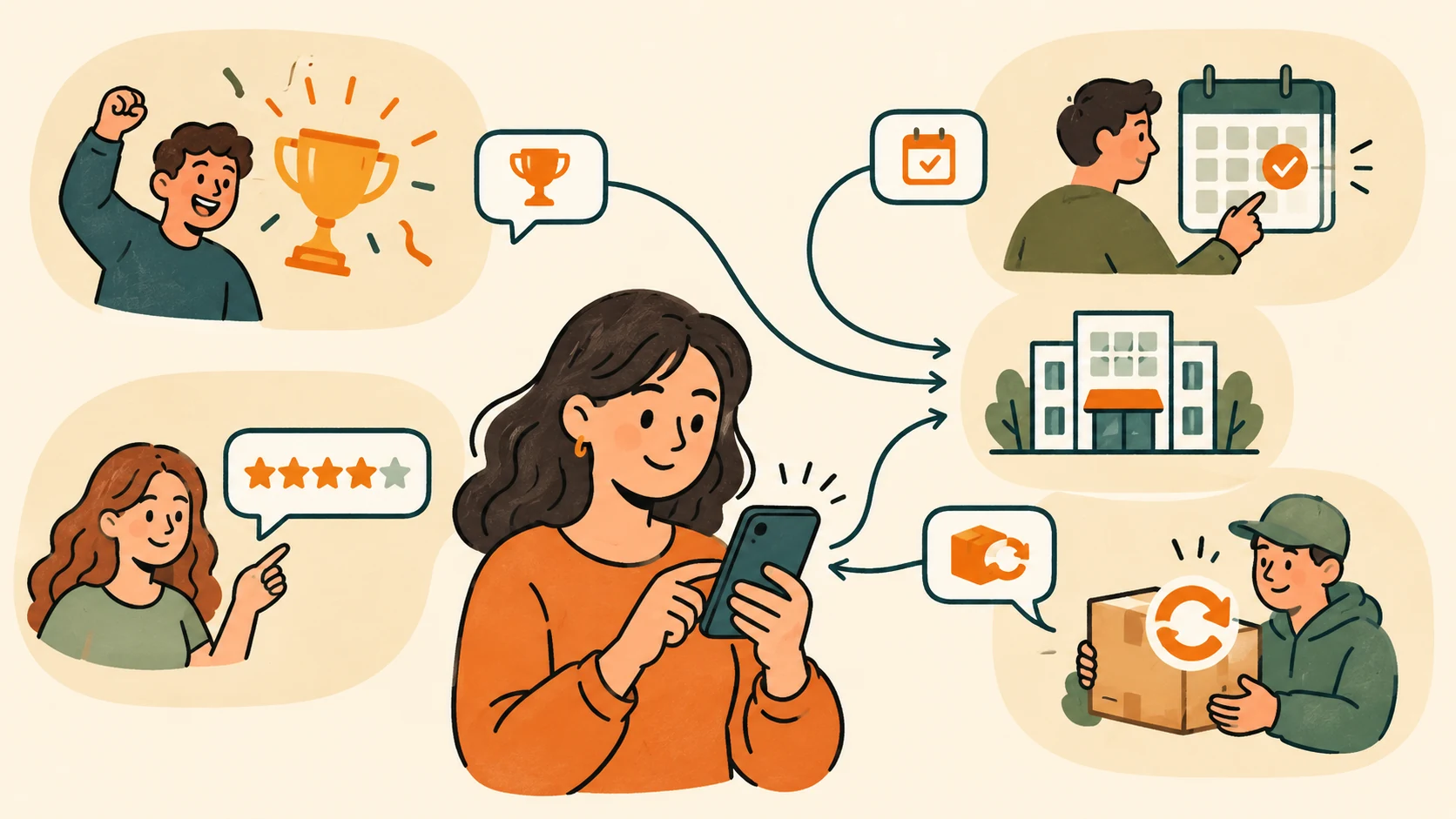
In an SMS contest, the participant sends a password, an answer to a question or a promo code. A properly configured system recognises such a message and records the entry.
When the task is to choose one of several answers, the contest password and the letter of the chosen option are enough.
Example 1 – SMS MO from a contest participant
KONKURS B
The organiser should prepare terms and conditions, define the rules for data processing and inform about the cost of the message. If the campaign meets the criteria of a lottery, the provisions of the Polish Gambling Act must also be taken into account, including the obligation to obtain the appropriate permit.
An SMS survey lets you collect opinions after a purchase or after service is completed. The customer replies with a short message, without opening a web form.
In an NPS survey the company asks, for example, how likely the customer is to recommend its services to someone else, on a scale from 0 to 10.
Example 2 – SMS MO with a customer rating
9
Replies can be saved in the system automatically and analysed later. SMS voting works in a similar way when each option is assigned its own code.
An appointment can be confirmed or cancelled with a short reply to a reminder. This is useful, among others, in medical practices, beauty salons, workshops and other businesses that take bookings.
Example SMS MT from the company:
„A reminder about your appointment tomorrow at 15:00. Reply TAK to confirm, or NIE to cancel”.
Example 3 – SMS MO from the customer
TAK
In a properly configured system, an SMS with the reply TAK lets you mark the appointment as confirmed. After receiving NIE, the system can pass the information to an employee or start the cancellation process.
The prerequisite is using a solution that can receive SMS replies. Sending messages from an alphanumeric sender name alone does not provide this feature.
When signing up for an SMS newsletter, the customer sends an agreed keyword and the system registers the sign-up. This is one of the stages of the process of subscribing to marketing communication.
The customer sends, for example, „START” to the number given in the instructions. The „STOP” command is used to handle opt-outs, if this unsubscribe method is provided for in the service.
Such a process, however, must be properly linked to marketing consents and data protection. An SMS alone is not always valid consent to marketing.
The company should clearly define the sign-up rules, the scope of consent and how it can be withdrawn.
To change the delivery date, the customer does not have to call the helpline straight away. They can send a short message with the order number and a request for a new date.
Example 4 – SMS MO about an order
ZAMÓWIENIE 12345 – proszę o dostawę w piątek. („ORDER 12345 – please deliver on Friday.”)
An employee can receive such an SMS together with the relevant order and check whether the date can be changed. When the system is integrated with the message receiving service, some requests can be handled automatically.
If an instruction requires identity confirmation, the whole process should not rely solely on the SMS content or the sender's number.
A poster, billboard or leaflet can encourage the viewer to send an SMS with the campaign keyword. Thanks to such a submission, the company can send offer details or record the response to the ad.
The poster can include the instruction: „Send OFERTA to [receiving number] to get the details”. The customer sends back the keyword „OFERTA”.
Keywords help assign submissions to specific campaigns. If the company plans further marketing communication, it must also take care of the required consents.
In some SMS Premium MO services, the message is a way to order paid content or a service. The user sends an agreed keyword to a Premium number and, after the charge is settled correctly, receives the service provided.
The customer sends the keyword „DOSTEP” to the number given by the paid service provider. This is an example of the mechanism, not a specific offer.
In this model, transparent information about fees is particularly important. SMS Premium should not be presented as a regular message charged at the standard tariff.
SMS MO is sometimes also part of user verification. In such a process the system asks the user to send a specific code or command from their phone to a given number.
The user sends, for example, „KOD 548621” to the given number. The system compares the content with the expected code; the digits are for illustration only.
This mechanism should be distinguished from the popular SMS authentication in which the user receives a code from the system. A message with a code delivered to the phone is an SMS MT.
Sending an MO message alone is not sufficient security. Security depends on the entire verification process.
Receiving SMS MO can be organised in several ways: through a panel, forwarding or integration with your own system. The choice depends above all on the number of requests and whether they are to be handled manually or automatically.
Client panel – inbox
In the web panel, an employee checks the SMS content and the sender's number. Such an inbox is useful when the company wants to handle requests manually, without building its own integration.
SMS API and webhook (callback)
If the provider offers a webhook or callback, it can send data about received SMS to a specified URL. The company's application then uses it to handle requests automatically.
In a booking system, a TAK reply can, for example, change the appointment status. A similar mechanism can be used in a CRM or an online shop.
Forwarding SMS to e-mail
With forwarding to e-mail, requests go to an employee's mailbox. There is then no need to check a separate SMS panel regularly.
Forwarding to another phone number
Some providers allow the content of SMS to be forwarded to an additional mobile number, e.g. to a customer service employee. Before using this feature, check its cost and how the original sender is identified.
Autoresponder – automatic MT reply
An autoresponder sends a pre-prepared confirmation after an SMS is received. If the platform supports it, you can also set separate replies for different keywords.
Example SMS MT from the company: „Thank you for your message. We have received your request and will pass it on for handling”.
The scope of available features must be checked with the provider. Not every SMS sending platform also allows receiving, forwarding and automatically replying to messages.
When receiving SMS, a company often processes personal data: phone numbers, request content or booking information. It should then define the purpose and legal basis of the processing and meet the information obligations arising from the GDPR.
This does not mean that consent to the processing itself is required in every situation. The appropriate legal basis depends on why the company receives and uses the messages.
Marketing is a separate issue. Under Art. 398 of the Polish Electronic Communications Law, using certain means of communication to send commercial information, including direct marketing, requires the prior consent of the subscriber or end user.
An SMS sent by a customer about an order or an appointment does not mean automatic consent to receive advertising.
If MO messages are to be used to sign users up for an SMS newsletter, the process should allow consent to be obtained correctly and its scope to be documented. It must also be possible to withdraw it. One way of handling opt-outs is a properly configured STOP command.
When organising contests and lotteries, the requirements for terms and conditions must also be taken into account, and for Premium services – the obligations related to informing about costs and the rules of using the service.
The detailed rules for data processing and running campaigns are best agreed with the person responsible for data protection or the company's legal team.
To receive SMS MO in a panel or your own system, a company needs a receiving number and a solution for handling incoming messages, usually provided by an SMS service provider. Being able to send bulk SMS does not by itself mean that the platform can accept replies from customers.
Launching the service can be divided into several stages:
1. Define the purpose of communication. Decide whether you need SMS MO to confirm appointments, collect feedback, handle requests or run campaigns.
2. Choose a provider. Check the message receiving options, available number types, billing models and integration features.
3. Choose a number for receiving SMS. Decide whether it should be long or short and whether it will be provided exclusively or in a shared model.
4. Configure keywords and replies. If the system supports such features, define the content recognised by the platform and the reply messages.
5. Choose how messages are handled. Decide whether the panel is enough or whether you need forwarding to e-mail or integration with your application via API.
6. Run tests. Check whether messages arrive correctly, whether the system recognises replies and what costs users bear.
7. Launch the service. Give customers the number, instructions for sending the SMS and the required information about costs and data processing.
To start with, one specific process is enough, e.g. confirming appointments. Tests will show whether the chosen receiving method meets the company's needs before it extends communication to further uses.
If you plan to connect SMS communication with your own system, check the capabilities of SMS API in SMS-FLY, which is used to automate sending messages. Receiving SMS from customers using the Individual Access Number (NDI) is described on the page dedicated to SMS branding. You can ask about the details of the service via the SMS-FLY contact form.
MO in SMS MO stands for Mobile Originated, meaning „originating from a mobile phone”. It denotes a message sent by a phone user. In business communication the term most often refers to SMS sent by customers to companies' receiving numbers, e.g. to confirm an appointment, take part in a survey or submit a request.
SMS MO is a message sent from a user's phone, while SMS MT (Mobile Terminated) is a message delivered to the phone. For example, a reminder sent by a company is an SMS MT, and the customer's reply is MO. Both mechanisms can work together in two-way SMS communication, if the service allows replies to be received.
The cost depends on the recipient's number and the operator's tariff. A regular SMS to a nine-digit number may be included in a message bundle. For short numbers, the billing rules must be checked separately. Messages sent to Premium numbers, on the other hand, involve the fee set for the given service, often higher than the price of a standard SMS.
For many Premium numbers starting with 7, the second digit indicates the net price, and for numbers starting with 9, the second and third digits matter. For example, the 925 range means PLN 25 net. Before sending a message, however, you need to check the price of the specific service in the operator's price list or the UKE register.
Yes. A company does not need a separate SIM card or phone to receive messages. It can use a virtual or shared number provided by the provider. The SMS then go, for example, to a web panel or the company's system. This does not mean receiving messages without any number, though – a receiving number is still needed.
A prefix is a keyword placed in the message content that helps the system recognise its purpose. It is useful especially when one number serves different companies or campaigns. For example, an SMS starting with the word WIZYTA can be routed to the booking system, and a message with another prefix – to a survey.
Yes, if the provider offers the appropriate integration. Received messages can be passed to the company's system via API, often using a webhook or callback. This way the application receives the sender's number and the SMS content, recognises the request and performs a programmed operation, e.g. changes the booking status or saves the reply in the CRM.
Yes, provided that the message receiving service supports an autoresponder. After receiving an SMS MO, the system can send the sender an MT message with a confirmation or further instructions. The reply can be the same for all users or depend on the keyword. Feature availability and the cost of sending must be checked with the provider.
SMS MO is a message sent from a user's phone that a company can use to receive customers' replies, requests and instructions. Combined with SMS MT, it enables two-way communication – from simple appointment confirmations to automated message handling. The choice of number and receiving method depends on the company's needs and the provider's capabilities. If you plan to develop SMS communication in your company, contact SMS-FLY and ask about the available solutions.